01 / Philip Wang

Research

Experiments, observations, and models. Exploring physical systems from collective droplet motion to the light of stars.

Soft Matter Research · Jan 2025–Present

Designing experiments for droplets in motion.

Prof. Eric Weeks’ Soft Matter Lab
Emory University

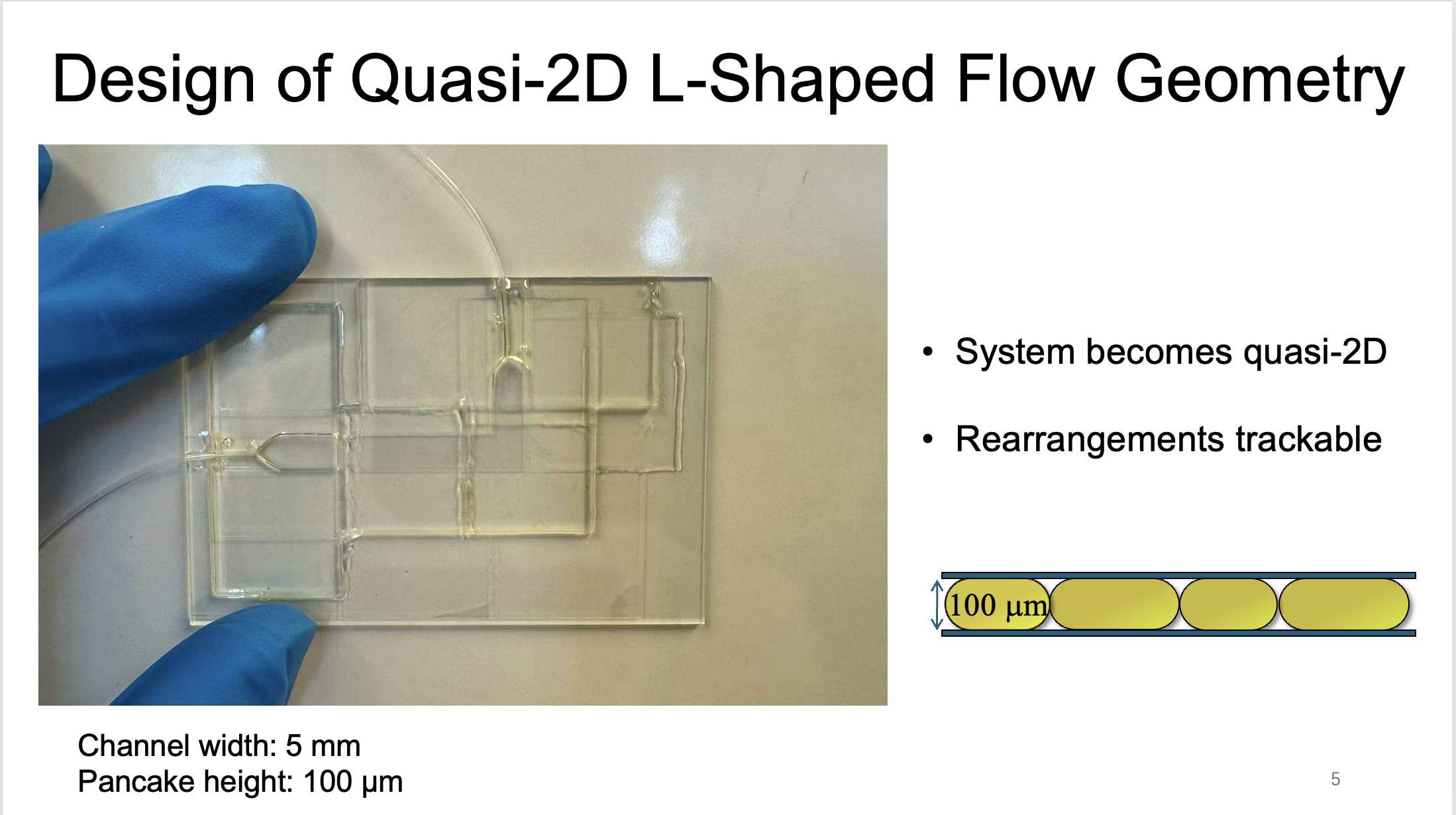
I design and fabricate L-shaped, quasi-2D microfluidic chambers to study highly polydisperse silicone oil-in-water emulsions under geometric confinement.

My Python pipeline combines Cellpose segmentation, size-aware trajectory linking, spatiotemporal velocity-field estimation, and forecast-assisted retracking. I have processed approximately 4.5 million droplet-frame observations to reconstruct individual trajectories.

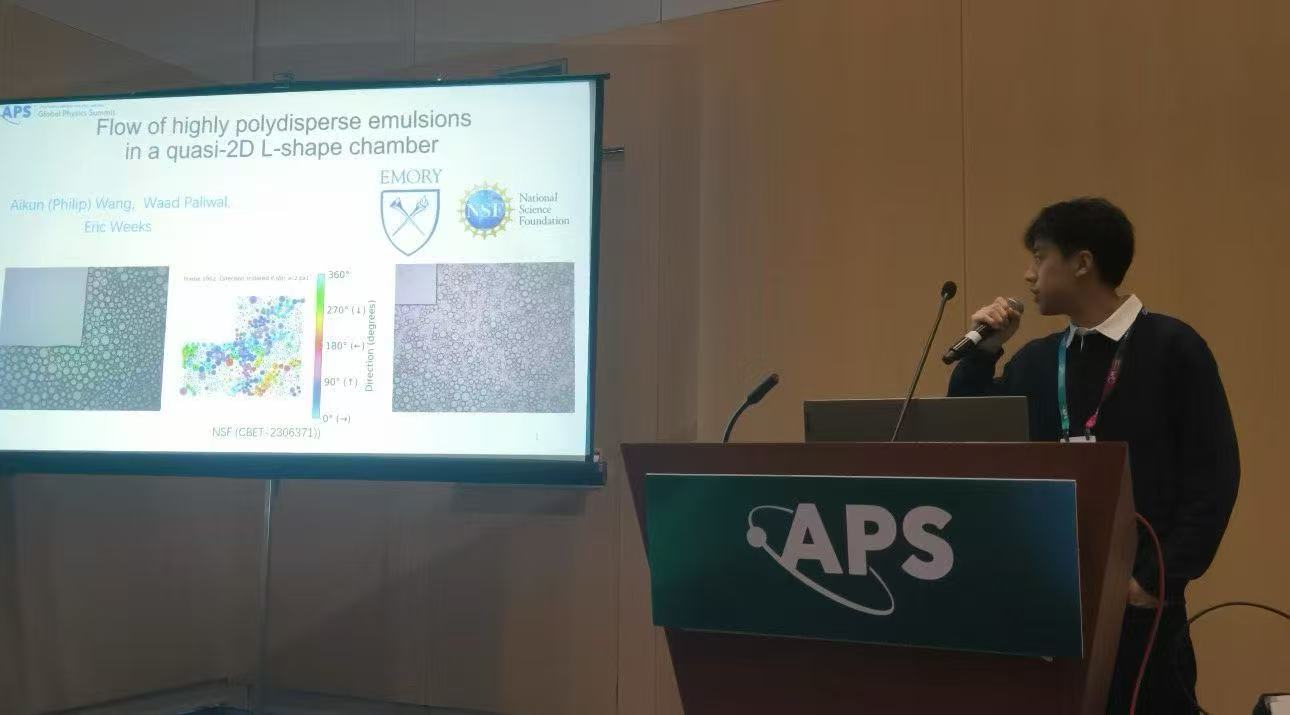
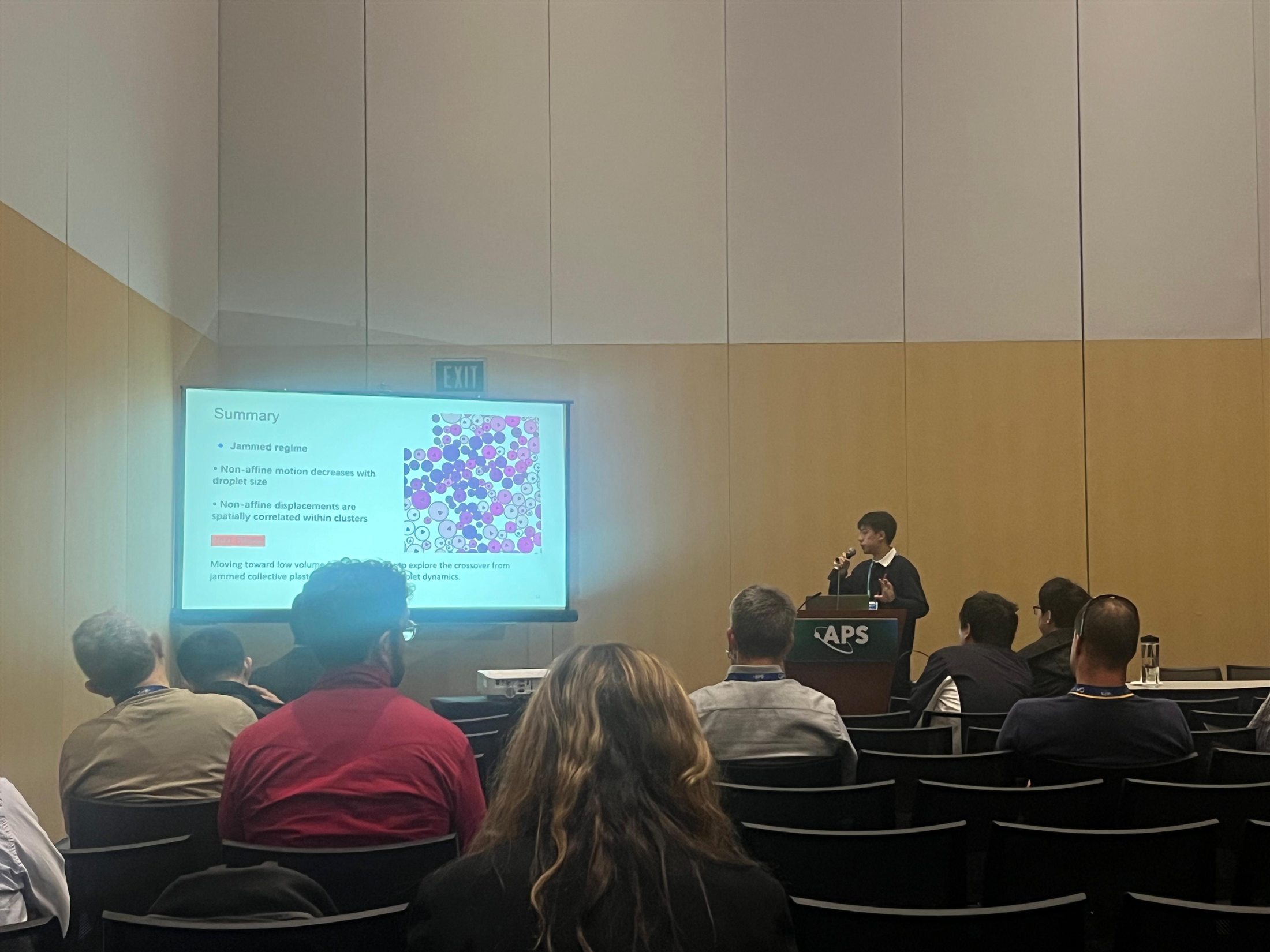
I analyze size-dependent transport, local area fraction, velocity distributions, and nonaffine dynamics to understand how particle size and crowding shape collective flow. I delivered an oral presentation at the 2026 Global Physics Summit and am contributing to a manuscript in preparation. My presentation at the 2027 Global Physics Summit in Atlanta, GA is confirmed and forthcoming.

MicrofluidicsCellposePythonParticle trackingNonaffine dynamics

Conference presentations

Confinement, motion & scale.

2027Atlanta, GAConfirmed presentation · Forthcoming

Global Physics Summit

Quasi-2D means a little bit 3D: Size-dependent droplet speeds in flowing quasi-2D emulsions

Aikun Wang, Waad Paliwal, and Eric R. Weeks

Confinement changes the size dependence of droplet speed; greater local crowding reduces speed differences between sizes.

Read full abstract

We investigate how droplet size and local area fraction affect motion in a highly polydisperse oil-in-water emulsion flowing through a quasi-2D L-shaped chamber. Due to the heterogeneity of the flow, individual droplet speeds are normalized by the local mean speed, averaged over space and time. We observe a pronounced change in the size dependence of normalized speed as droplet diameter becomes comparable to the chamber height. The small 3D droplets travel at the speed of the fluid, whereas the larger 2D droplets slow with increasing size due to viscous drag against the confining walls. This size dependence is stronger at lower local area fractions. Increasing local area fraction reduces these differences, suggesting that crowding couples the motion of droplets of different sizes. These results highlight how confinement and local packing together regulate droplet motion in polydisperse emulsions.
2026Denver, COOral presentation · Presented

Global Physics Summit

Nonaffine motion of highly polydisperse emulsions in a quasi-2D L-shaped chamber

Aikun Wang, Waad Paliwal, and Eric R. Weeks

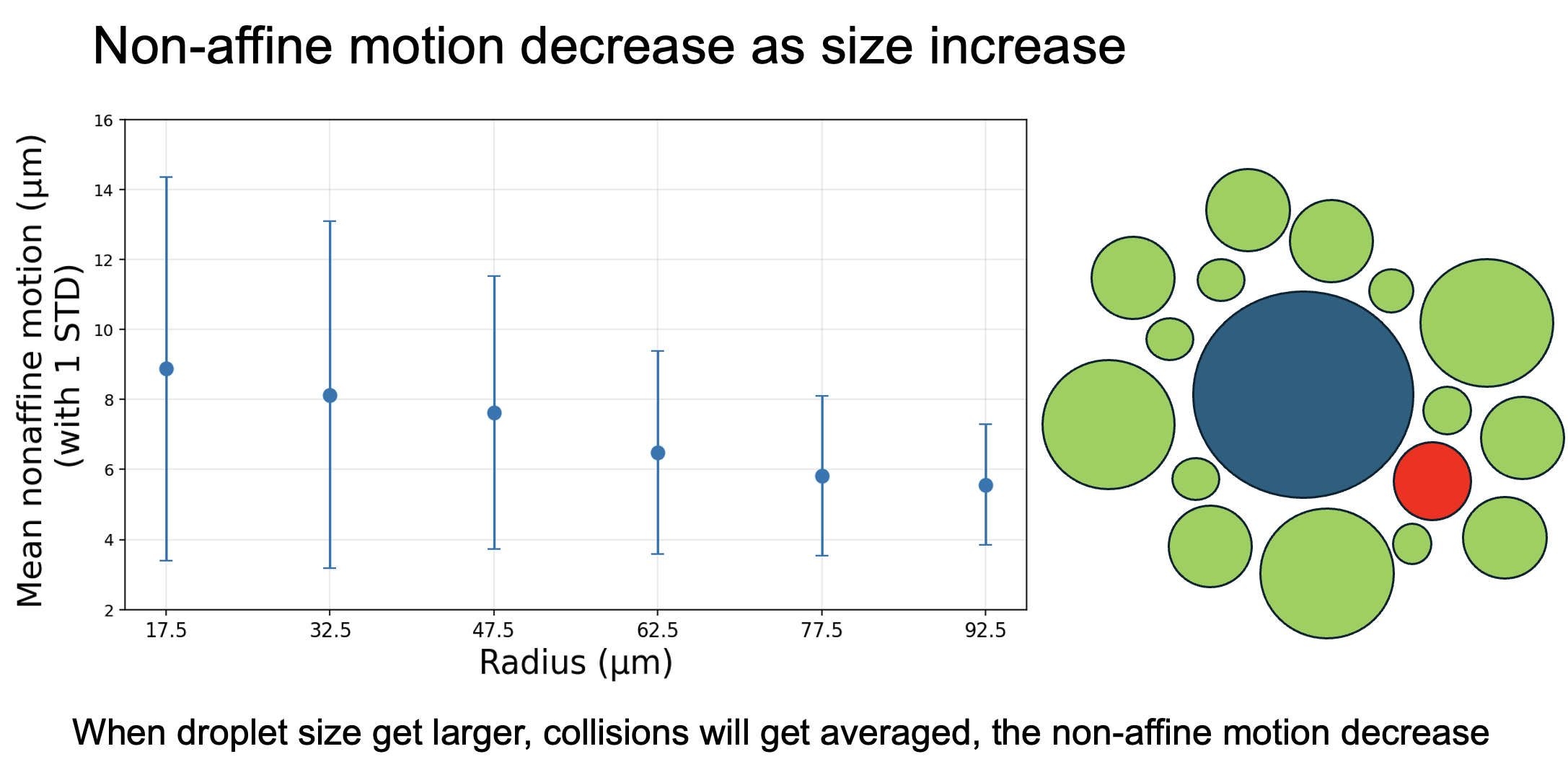
Smaller droplets rearrange around larger neighbors, showing greater nonaffine motion as the emulsion flows around a confined corner.

Read full abstract

We investigate the flow of highly polydisperse emulsion droplets confined to a quasi-2D geometry. We produce stable oil-in-water droplets with an average radius of ~40 μm, spanning a size range from ~20 μm to ~200 μm, and a polydispersity index of 0.4. The droplets are driven through a custom-designed L-shaped chamber with height 100 μm. Droplets are forced to rearrange as they navigate around the corner of the L-shaped flow chamber. The nonaffine motion is the difference between the time-and-droplet-averaged flow field and the instantaneous displacements of individual droplets. We observe the largest droplets having distinctly different flow behaviors than the smallest droplets: the smallest droplets frequently have to move around the larger ones, giving the smallest droplets more nonaffine motion. We also study how the nonaffine motion depends on the area fraction of the droplets, ranging from dilute to jammed conditions.

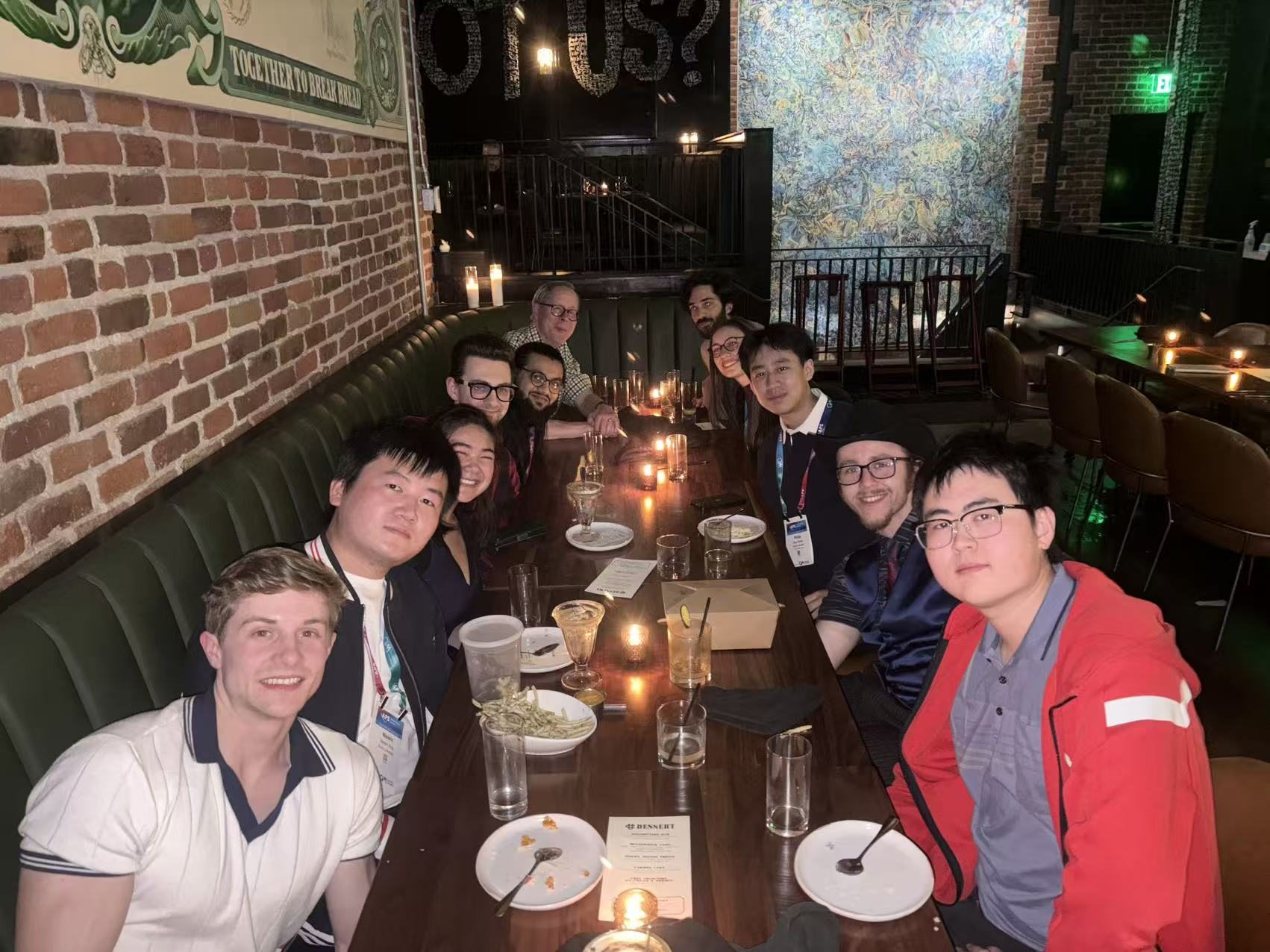
Conference photographs ↗
Quasi-2D L-shaped flow geometry design slide Experimental design

L-shaped chamber

Quasi-2D L-shaped flow geometry designed to make rearrangements trackable in droplet systems.

Analysis pipeline

Tracking algorithm

Tracking video from the Python and machine learning workflow used to extract droplet motion.

APS result slide showing non-affine motion decreases as droplet size increases Hydrodynamic analysis

Nonaffine motion vs size

Brief-view result showing that larger droplets average collisions and reduce non-affine motion.

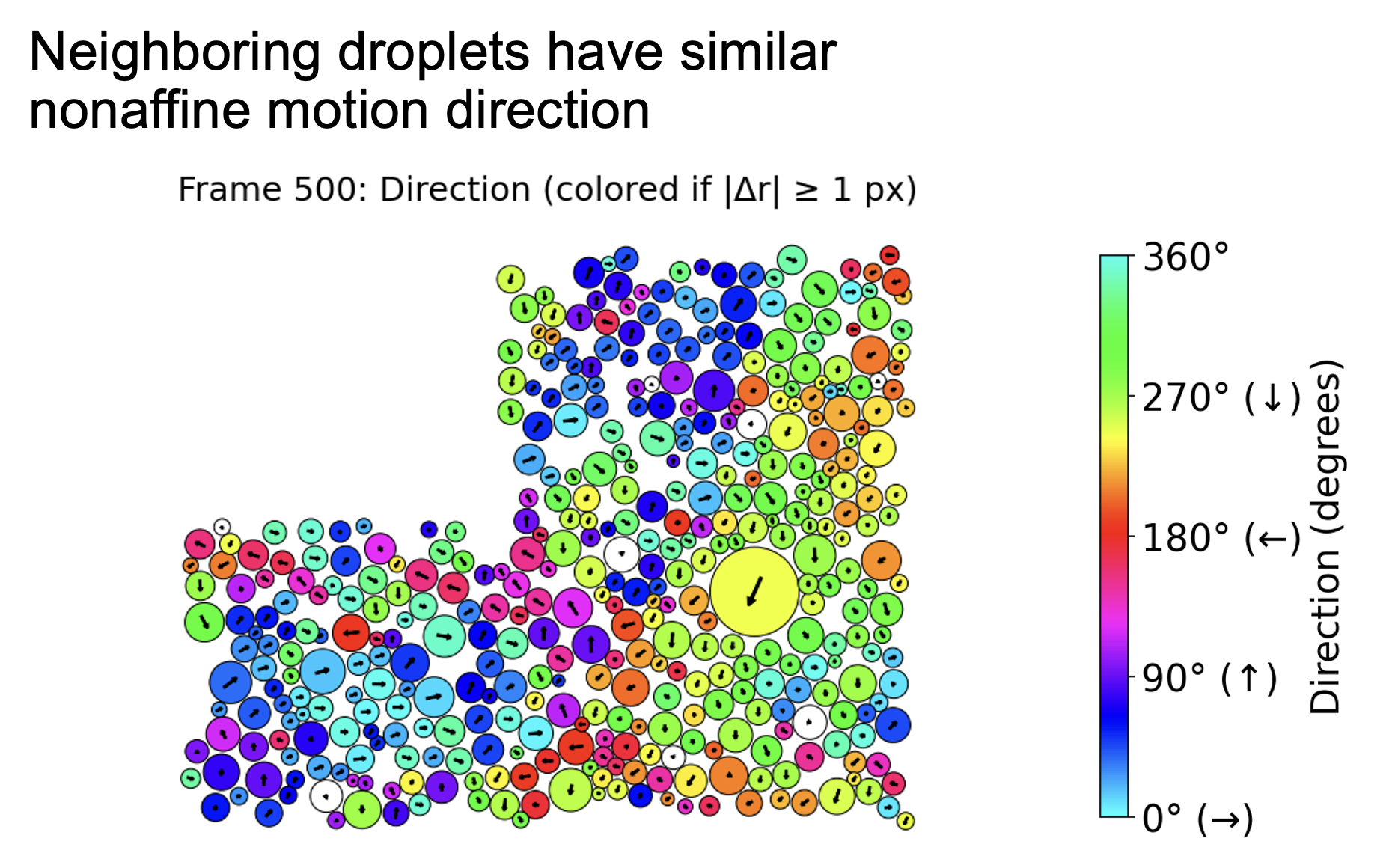
Neighboring droplets nonaffine motion direction analysis Hydrodynamic analysis

Nonaffine motion direction

Brief-view result showing neighboring droplets with similar non-affine motion direction.

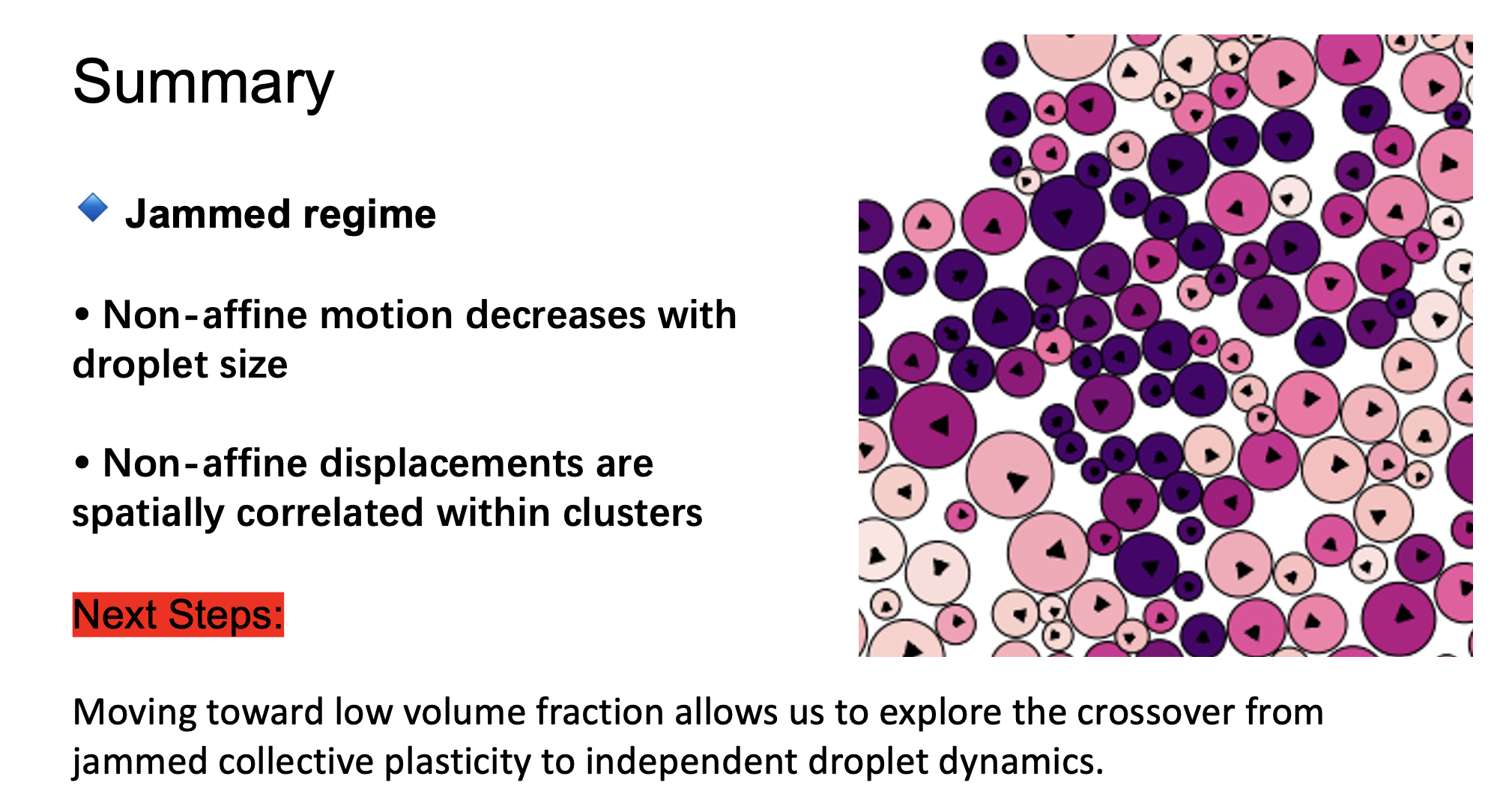
conference summary slide about jammed regime and next steps Research summary

Jammed regime and next steps

Final conference summary connecting droplet size, spatially correlated displacement, and the next low-volume-fraction regime.

Astrophysics

Classifying objects through spectra, images, and models.

As a Physics & Engineering Science student with a minor in Astrophysics at Emory, I have studied how stars and planetary systems form, evolve, and reveal their physical properties through spectra, photometry, and multi-wavelength observations. My coursework and projects have connected star formation, stellar classification, young stellar objects, binary systems, exoplanet detection, and planet formation.

Across these projects, I worked with spectral energy distributions, photometry, spectra, GAIA measurements, parallax, and sky coordinates to turn observational data into physical interpretations.

Star formation Stellar classification Planet formation Stellar evolution YSOs Binary systems Exoplanet detection
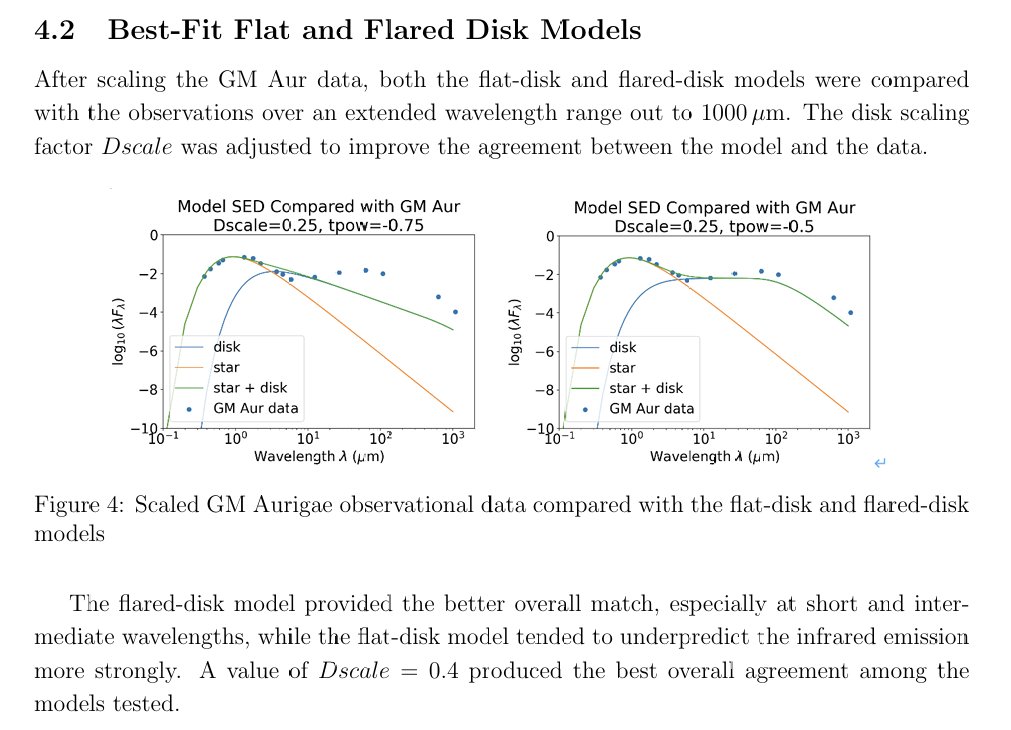
Preview of SED model report SED modeling

Disk model matching

Built flat and flared disk models to compare observed spectral energy distributions with expected star-disk behavior.

Read SED report
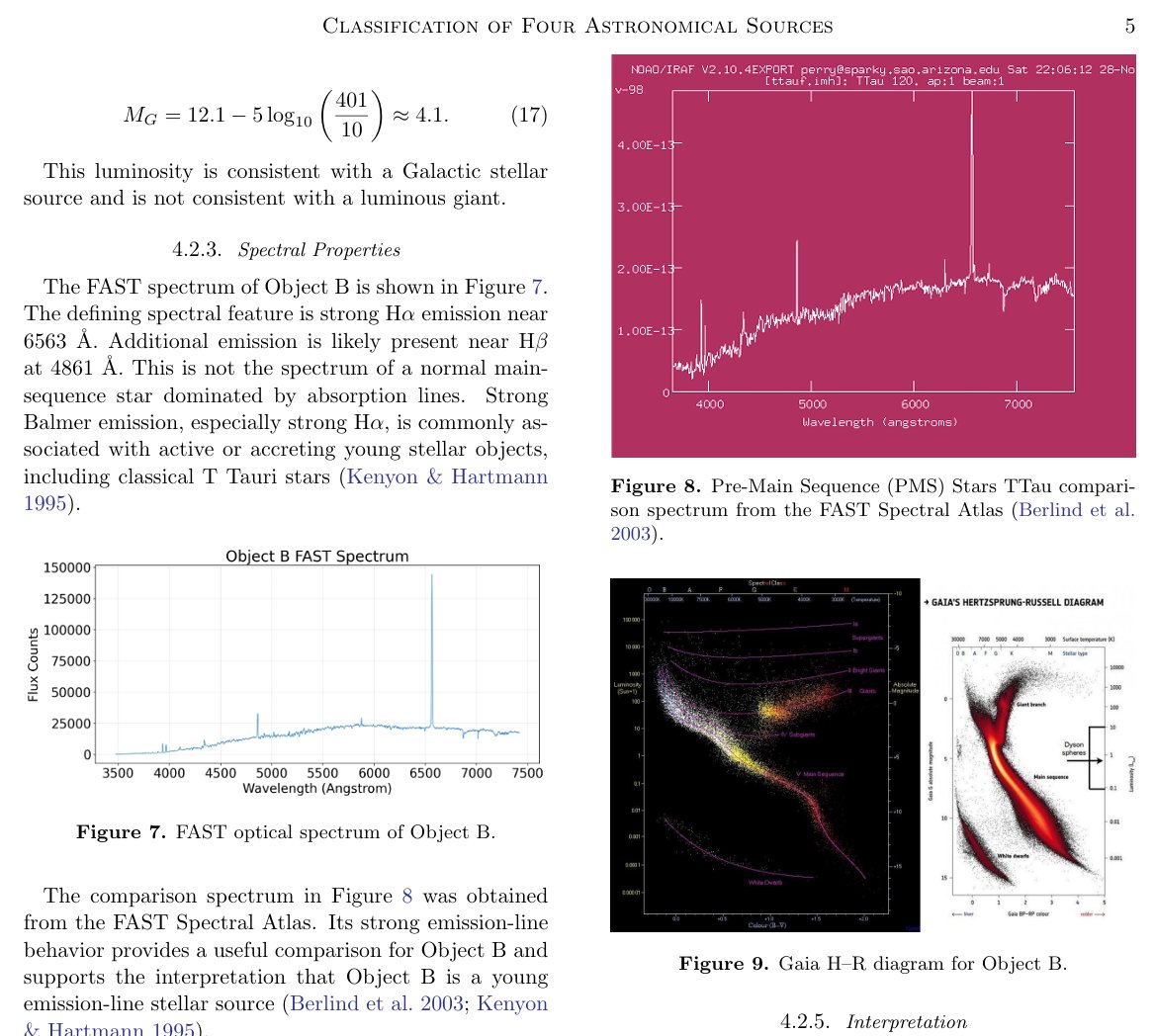
Preview of four-object classification report Stellar classification

Classifying the Stars

Used spectra, multi-band images, GAIA data, parallax, and sky coordinates to identify four astronomical sources.

Read classification report
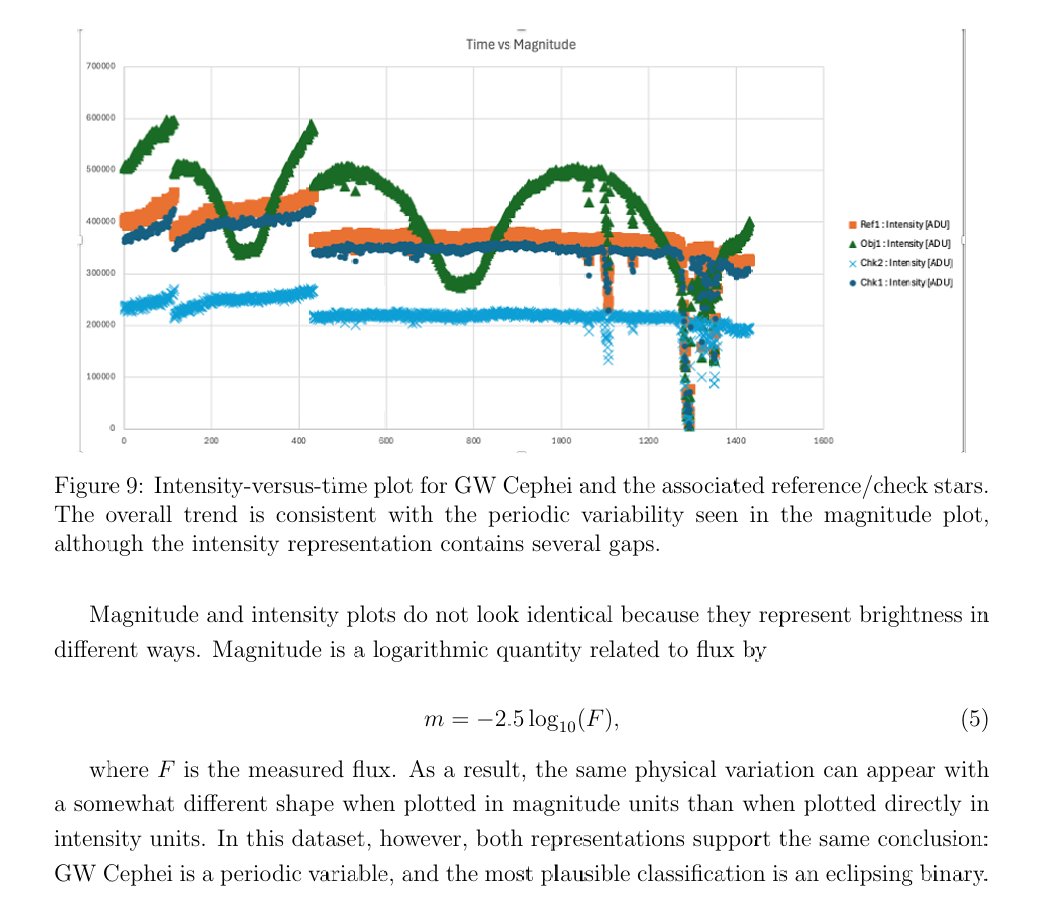
Preview of photometry application report Photometry

Variable star analysis

Analyzed time-series brightness behavior through magnitude and intensity plots to classify variable objects.

Read photometry report

Research beyond the lab

OpenRefinery

STEM Research Program Participant | AI for Science

  • Participating in the AI for Science initiative to explore AI applications in real-world STEM research workflows, with a focus on experimental soft condensed matter physics.
  • Contributing domain knowledge in microfluidics, microscopy-based particle tracking, and computational data analysis to interdisciplinary efforts connecting scientific research and AI development.

Chinese Virtual Observatory | Popular Supernova Project

Researcher

  • Independently analyzed more than 6,000 astronomical images and reported over 50 suspicious objects during a three-year observing period.
  • Discovered a previously unknown variable star in NGC 3238; further investigation is ongoing.

Get in touch

Let’s start a conversation.

Research, creative projects, or a shared curiosity.